The Evolution of the Modern Recruitment Consultant: From Administrative Bottleneck to High-Value Strategist

 6 min read



Introduction
For decades, the standard textbook answer to the question “What does a recruitment consultant do?” involved an exhaustive checklist. A traditional recruitment consultant was expected to balance two different acts.
One one hand they had to handle clients, cold-call businesses, negotiate service agreements, post vacancies, source the candidates, manage their pipelines, manage compliance checks, and chase their own invoices.
This was the reality until digital talent marketplaces showed up and created infrastructures that rewrote the roles for the modern recruitment consultant.
Recruiting Consultants and the Flaws of the 360 System
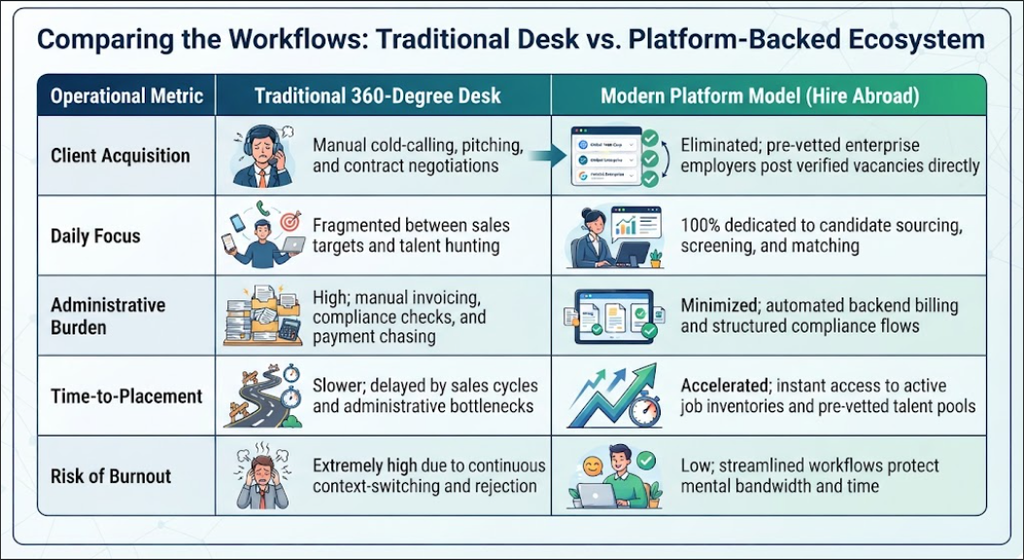
This all-encompassing operational style we just mentioned is known as the traditional 360-degree or full desk recruiting model. It is sometimes still perceived as the top of recruiting excellence as it requires professionals to have a lot of experience, patience, and work dedication. Still, the 360 model forces independent operators and agency staff to act as sales development reps, account managers, headhunters, and compliance officers all at once.
And let’s face it, with more and more blue-collar jobs being in high demand, while finding the right people for the roles becomes increasingly difficult, working with the full desk 360 system will only lead to recruiter burnout. When professionals spend up to 25 hours a week trapped in administrative drag, like formatting CVs, updating spreadsheets, and tracking down payments, their core function, which is actually finding the right people, suffers.
Fortunately, the rise of modern digital talent marketplaces and infrastructure-backed platforms is rewriting the rules. By stripping away cold-calling and operational overhead, these platforms are transforming the role of the modern recruiting consultant from a stressed-out generalist into a high-earning, focused talent-matching strategist.
What Does a Recruitment Consultant Do? (The Traditional vs. Modern Reality)
To understand why the staffing industry is undergoing a structural shift, we first have to examine the traditional job description of a legacy staffing professional.
The Traditional 360-Degree Daily Grind
In a classic agency setting, a recruitment consultant divides their working hours between two entirely different professional disciplines:
- Business Development (The Sales Side): Cold-calling employers, pitching staffing agreements, managing client accounts, and securing vacancies.
- Candidate Sourcing (The Talent Side): Sourcing active and passive candidates, screening resumes, conducting intake interviews, and managing talent pipelines.
In theory, this gives an independent recruiter complete ownership over their business and how much they earn. However, in practice, this double process is time consuming and comes with a lot of bottlenecks.
Trying to send out high-volume sales pitches while simultaneously building trusting, detailed relationships with job seekers creates an unsustainable operational standstill. Something always has to give, and it is usually candidate care or the mental wellbeing of the recruiter..
The Modern Shift: Specialization Through Ecosystems
High-performing consultants nowadays know that if they want to be successful, they can’t and shouldn’t concentrate on every aspect of the full desk grind. They, instead of doing everything on their own, take advantage of specialized digital infrastructures and marketplaces.
By utilizing platform-backed models, consultants can eliminate the sales friction of client acquisition and focus entirely on candidate advocacy, matching, and pipeline optimization.

Anatomy of the Burnout: Why the Legacy Model Fails
Why is the tradition becoming less popular among independent recruiters and boutique agency owners? The answer lies in three major industry hurdles and one simple mental problem: burnout.
1. The Context-Switching Tax
Sales requires you to create a follow through with an aggressive, high-volume outbound strategy. And the worst part of it: you will run into constant rejection, often even unable to present the value in your pitch. More specifically, cold-calling yields a success rate of only 2-3% across industries.
On the other hand, talent sourcing and interviewing require entirely different cognitive skills: active listening, patience, empathy, and deep technical knowledge. Bouncing back and forth between closing B2B sales contracts and interviewing candidates destroys deep-work productivity.
2. The Time Crunch in Fast-Moving Markets
In fast-paced sectors like European cross-border blue-collar hiring, being quick is your best bet for success. If you spend most of your time dealing with cold emails, negotiating terms, and chasing invoices, chances are, your competitors with less obligations will build their talent pools faster. And by the time a deal is secured, top-tier candidates have already accepted other roles.
3. Administrative Drag and Cash Flow Friction
Endless paperwork slows down the hiring lifecycle. Invoices, payment tracking, compliance checks, and resolving disputes take up hours of your day. For independent recruiters, waiting 30 to 60 days to get paid causes unnecessary stress and holds back business growth.
How Digital Marketplaces Redefine the Rules
The evolution of modern staffing platforms bridges the gap between independent entrepreneurship and enterprise support. Rather than forcing consultants to do everything by themselves, platforms like Hire Abroad provide a unified operational backbone designed specifically for blue-collar, cross-border international recruitment.
Zero Business Development Hassle
On these platforms, client acquisition headaches are effectively non-existent. Since we are talking about an active blue-collar marketplace, major enterprise and verified manufacturing and logistics brands from Germany, Belgium and the Netherlands are also already active on the platform, with their verified vacancies.
Recruiters just simply log in and browse the ready-to-fill jobs. There is no need to spend weeks cold-calling plant managers or negotiating baseline SLAs. The market demand is already secured, allowing consultants to channel 100% of their energy into candidate matching.
What’s even better is that those who choose to partner with us, also get their own free recruitment website which is already populated with these vacancies.
Eradicating Administrative Drag
Platforms handle the heavy operational work. Automated invoices, compliance checks, and standard paperwork remove the manual tasks that slow down traditional agencies. Recruiters get back up to a quarter of their weekly work hours, letting them spend that time focusing on candidates instead.
This enables them to find better people for the roles they recruit for, and also open up more time for recruitment specialization for those hard-to-fill roles, like electricians, drivers, plumbers, and welders.
Predictable, Transparent Earnings
Financial security is essential for freelance scaling. Instead of chasing late client payments or dealing with unpredictable commission disputes, platform-backed models provide reliable monthly payouts. With transparent fee structures (such as guaranteed payouts ranging from €520 for entry-level placements up to €1,040 for skilled worker deployments) consultants can accurately calculate their revenue and achieve true financial independence.
Comparing the Workflows: Traditional Desk vs. Platform-Backed Ecosystem
The Future Belongs to Specialized Strategists
Fortunately, being a professional recruiting consultant doesn’t mean that you have to do everything a full 360-degree desk requires. True autonomy and freedom is no longer about doing everything all at once. It’s about using a system that eliminates the tasks that aren’t in your job description in the beginning. This projects your time and boosts your professional capacities where it counts.
By stepping away from administrative chaos and cold-calling hurdles, modern consultants can build scalable, high-yielding careers. Through specialized ecosystems like Hire Abroad, the path forward is clear: drop the burnout, embrace digital infrastructure, and get back to what you do best: connecting great talent with the global opportunities they deserve.
Feel free to reach out to us if you want to learn more.