In-House vs. Outsource: Why Outsourcing Recruitment is the Best Way to Save

 6 min read



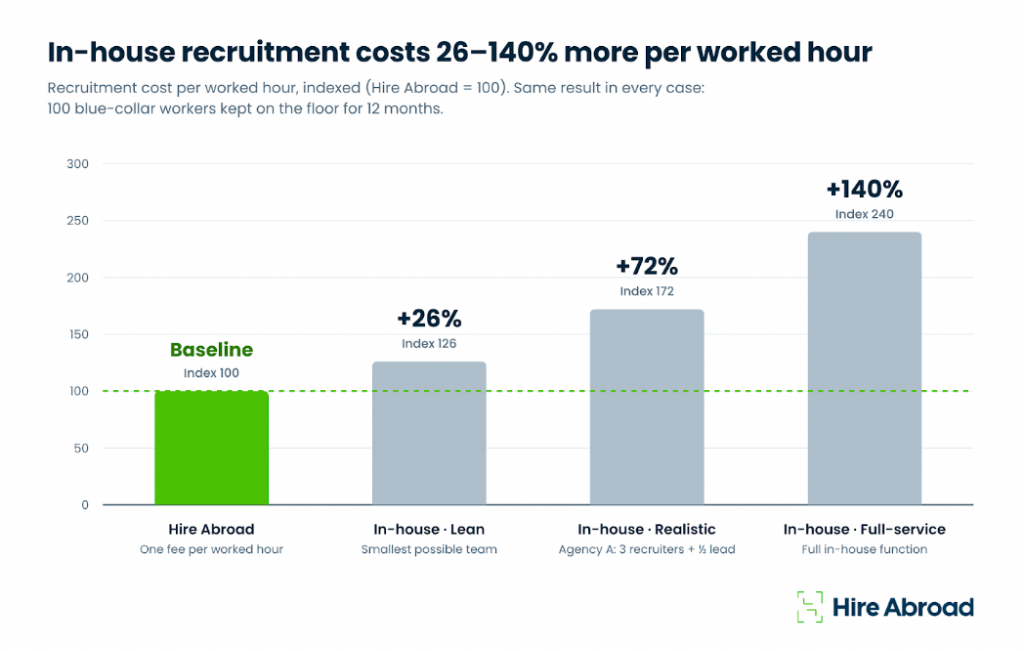
An in-house recruitment team costs 26% to 140% more per worked hour than working with Hire Abroad. The main reason is simple: you pay an in-house team every month, and you pay Hire Abroad only for the hours that workers work.
This article shows how we get to these numbers. We compare two options for a staffing agency: build your own recruitment team, or work with a partner like Hire Abroad. We use one example for both: keeping 100 blue-collar workers at work for one full year.
In-House Vs. Outsource Recruitment: Why This Question Matters
Filling 100 spots sounds simple: It’s classic high-volume recruitment. But in blue-collar, where workers usually arrive from abroad, high turnover is normal. Workers quit, find other options, get promoted, return home, or stop early. This means you do not hire 100 people once. You hire many more, again and again, through the year.
Blue-collar staffing has a high rotation rate. This means that often, you will end up hiring 150-200 people throughout the year to keep those 100 spots filled. This is something you often can’t fully control, and a hidden cost many companies don’t plan for.
Have Your Own Recruitment Team
Having your own in-house recruitment team means paying for a lot of things at once. And these costs will stay not only during the high season but the slow months as well. These costs include:
- Recruiters: Salaries plus mandatory employer taxes.
- Management time: A manager or team lead to oversee the recruiters.
- Marketing: An agency retainer or in-house marketing staff.
- Paid ads: Ongoing spend on job ads across platforms.
- Job boards: Postings on national and international job sites.
- Software: ATS, CRM, and phone systems.
- Hardware: Laptops, phones, and office space.
- Compliance: ID checks, certificates, and housing coordination.
Again, you pay these expenses every month. And under Dutch labour law, cutting staff quickly is slow and expensive. Crossing dismissal rules and not giving notice periods may also get you extra fines, draining your budget even more.
Work With a Partner
The structure is different if you work with a partner like Hire Abroad. You pay one fee, only for the hours actually worked, and no other costs.
This means:
- No recruiter salaries.
- No ad budget.
- No job board contracts.
- No software licences.
- No hardware costs.
If no workers are placed, there is no invoice. The cost moves up and down with your real needs.
The Numbers, Side by Side
To compare the two options fairly, we look at the total annual cost for the same result: 100 workers, held for 12 months.
| Model | Cost per worked hour | Fixed cost if hiring stops | Model | Cost per worked hour |
| Hire Abroad | Baseline | None | Hire Abroad | Baseline |
| In-house (Lean) | +26% | High | In-house (Lean) | +26% |
Note: both models leave out the workers’ wages. You pay these in both cases. The table compares only the cost of recruitment.
A lean in-house setup costs 26% more per worked hour than Hire Abroad. A realistic setup costs 72% more. A full-service setup costs 140% more.
An Example: What One Agency Could Save
This example is made up. Agency A does not exist, and the amounts are estimates. Your own numbers will be different.
Agency A wants to keep 100 international workers on the floor for a full year. It builds a realistic in-house team: three recruiters and a team lead who spends half of their time on recruitment. These costs come back every month:
| Expense Category | Monthly Cost |
| Three recruiters (salary and employer costs) | €13,650 |
| Team lead, half of their time | €3,100 |
| Paid ads | €3,000 |
| Job boards | €1,500 |
| Software (ATS, CRM, phones) | €600 |
| Laptops, phones and office space | €1,000 |
| Compliance and admin | €1,000 |
| Total per month | €23,850 |
That is about €286,000 per year. Agency A pays this in the busy months and in the slow months. In our comparison, a realistic in-house setup costs 72% more than Hire Abroad for the same result. For Agency A, that means about €10,000 less per month, or about €120,000 less per year.
Again, this is an example and not a promise. What you save depends on your wages, your roles, your turnover, and the number of workers you need. Some agencies will save more, and some will save less.
“But a Staffing Agency Markup Is Different”
Some clients compare our fee to a traditional staffing markup. This comparison is not correct, and here is why.
A traditional staffing markup covers the full cost of the worker. This includes the wage, taxes, holiday pay, and the agency’s margin. It usually adds 70% to 100% on top of the hourly wage.
Our fee is different. We do not touch payroll. The client keeps the workers on their own books and pays their wages directly, as they always would. Our fee only covers the recruitment work: sourcing, screening, documents, and delivery. This is a small fee, equal to about 5–6% of a minimum wage hour.
In short: a staffing markup buys the worker. Our fee buys the recruitment process only.
Why Flexibility Matters
The real difference between these two models is the most obvious when hiring slows down completely. In the case of an in-house team, your expenses are still the same. You still have to pay salaries and taxes for the recruiters. With Hire Abroad, if no workers are placed, there’s no invoice to pay.
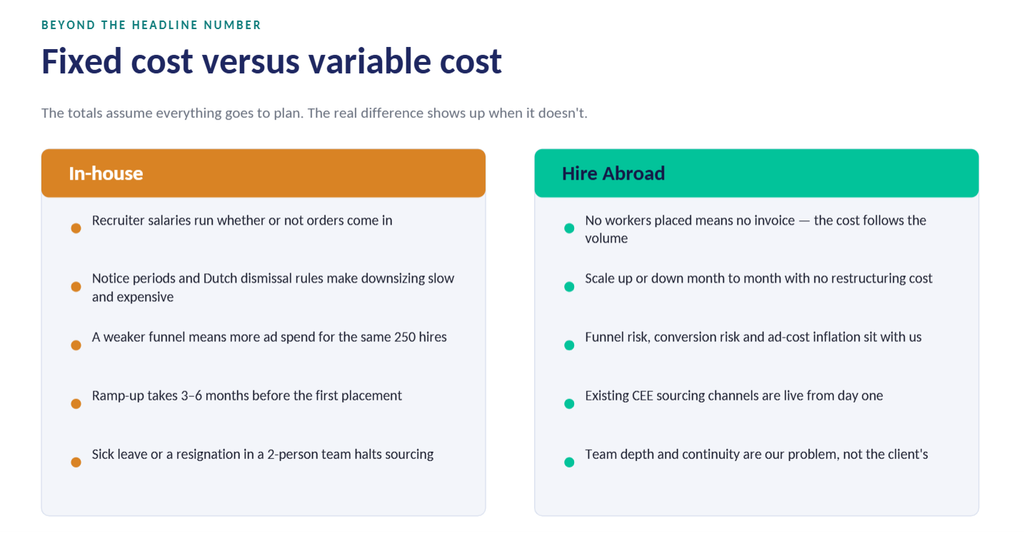
At the same time, if there are problems with your hiring funnel and you don’t place as many workers, you still need to pay your recruiters and pay more for ads to place the required number of workers. With Hire Abroad, this funnel risk sits with us, not you.
Building a new in-house team also takes time. It can take several months before the first placement. Our sourcing channels in countries like Poland, Romania, Lithuania, Portugal, and Spain are already active. There is no ramp-up period.
Scale Your Operations With Your Needs
Building an in-house recruitment team is a high, fixed cost. It does not adjust easily when demand changes. Working with a partner like Hire Abroad turns this fixed cost into a flexible one. You only pay for the hours actually worked, and the recruitment risk moves to us.
For the same result- 100 workers held for a full year- the numbers show a clear outcome: a lower total cost and a model that adjusts with your real needs. Want to see how this applies to your own hiring volume? Get in touch with our team