The international recruitment market is entirely biased. Companies from the Netherlands, Belgium, or Germany hiring international employees have their preferences when it comes to choosing nationalities for their teams. These preferences are shaped by past experiences, media, and the people that surround them. However, these are heavily biased resources for getting information about the nationality or culture of the team you would like to build.
The quality of the work ethic of foreign employees depends on how you recruit them and your organization’s preferences. How would you like to develop yourself as an organization, and how are international employees a part of this? Is a foreign employee a temporary solution for a short-term lack of people, or do you see them as an asset that can develop within your organization? Let’s learn more from Johan van Zutphen, our CEO and founder..
Differences Between International Employees From Different Countries

At Vilnius University’s international business and management studies, I attended a course about foreign cultures and differences, which offered a lot of insight about different cultures that can be applied to international recruitment. The lecturer used the cultural dimension theory of Geert Hofstede, who developed his original model by using factor analysis to examine the results of a worldwide survey of employee values by IBM.
The theory includes five dimensions on how to analyze cultural values:
- Long-term vs. short-term: This dimension connects the past with the current and future actions and challenges.
- Uncertainty avoidance: Looks at the degree to which individuals in a society accept the unexpected.
- Power distance: Measures the acceptance of social hierarchy within a culture and to what degree employees agree with unequal power distribution within organizations.
- Masculinity versus femininity, or task-oriented vs. people-oriented: In a masculine culture, men are expected to be assertive, competitive, and focused on material success. A feminine culture is more focused on people and quality of life. Gender roles are freer in feminine cultures.
- Individualism vs. collectivism: The degree to which a society is integrated into groups.
When old studies used Hofstede’s ideas to say how different cultures are, did those findings match what we’ve seen when we’ve hired people from those different cultures?
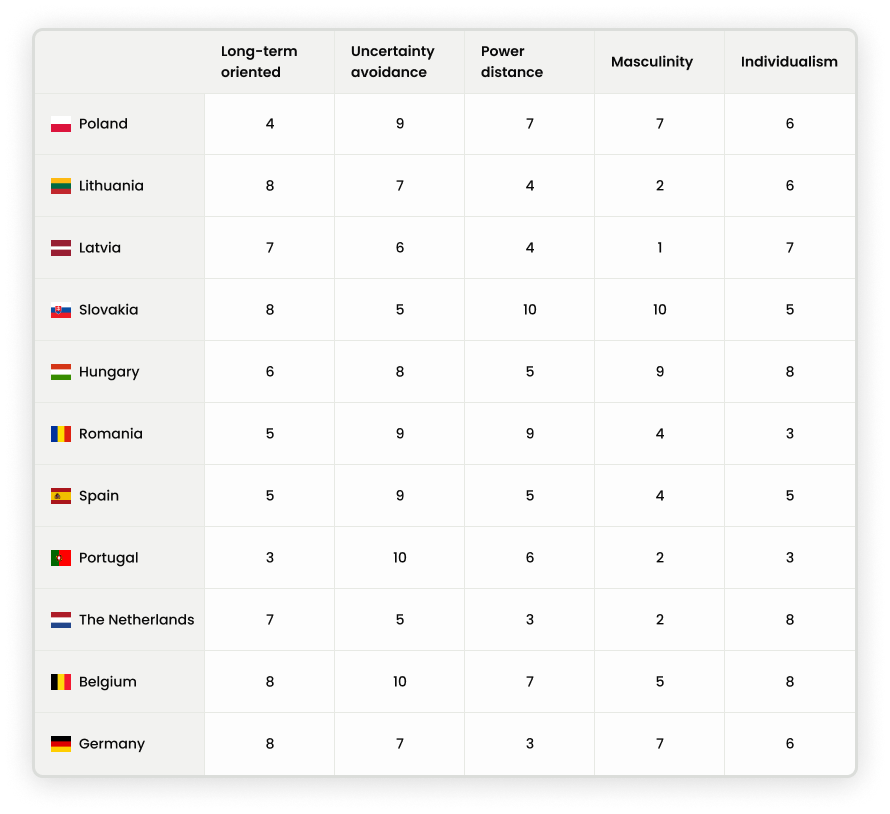
The table below illustrates the results of the cultures in which our business is actively operating. The countries where international workers come from are listed first, and the countries where foreign workers go to work are next: the Netherlands, Belgium, and Germany.
An approximate rating from 0 to 10 is used to keep it simple.
How Are Cultural Differences Reflected When You Hire International Employees?
Long-term Oriented
There is a significant difference in the long-term orientation of European cultures. The countries where international workers will work, such as Germany, Belgium, and the Netherlands, are generally long-term oriented.
From the sourcing countries, Lithuania and Latvia are similarly long-term oriented. This long-term view is reflected in the data we collected recently among people recruited from different countries. We noticed that international candidates from Lithuania and Latvia are less likely to switch jobs from one agency to another than Polish employees, who are more likely to change agencies for more short-term economic advantages (like better pay).
What data doesn’t match is Portugal. From our insights, we see that Portuguese international workers stay for a similar amount of time abroad as Lithuanians. For many Portuguese, the decision to move to work in another country is based on a desire to build a future there.
This is because of the history of international employment between Portugal and, for example, Lithuania. Lithuanians have a long history of going to work in the Netherlands. The Portuguese who are going to work in the Netherlands are the pioneers, checking different options for a better future elsewhere.
Uncertainty Avoidance
It shouldn’t come as a surprise that Germany and German companies tend to avoid risk source candidates from countries that have previously proven to be reliable workers. On the other hand, there are also risk-avoiding cultures, like Portugal, Romania, and Poland.
Candidates from these countries are trying to mitigate risks before going to work abroad; for example, they ask many questions and want to learn more about accommodation, company culture, employee benefits, the hiring process, foreign labor laws, the prevailing wage, etc.
For international professionals who are avoiding risk, it would be good to give preliminary contracts, for example, or to provide referrals of people who previously worked at your company.
On the other hand, Slovakian experts don’t look at uncertainty with fear. Data shows that they are more likely to be ready to take the risks that may arise from working abroad. In our business, we also noticed that for Slovakians, providing additional documents, such as preliminary contracts, is not preferred. Instead, they value ease and speed.
Generally, recruiters need more energy to acquire international talent from Romania and Portugal than from Lithuania and Latvia. Offering comfort and trust go hand-in-hand with providing personal attention to people, which requires time and energy. Personal care, on the other hand, is a way to create a close relationship with people.
Power Distance
It is interesting to notice the big difference between the Netherlands and Belgium when looking at the importance of hierarchy or the power distance within a culture. While in the Netherlands, flat hierarchy and flat organization structures are the most common, in Belgium, a strong hierarchy can be found within most businesses.
For Dutch managers, it requires less energy to work with Lithuanians and Latvians, who place similar importance on power distance as those from the Netherlands, compared to working with Polish and Slovakian employees, who are significantly influenced by power distance in their culture.
What is happening in companies in the Netherlands is the following: Where most of the managers are of Polish origin, there is a harder time working with Lithuanian and Latvian employees. It is easier for a Polish manager to work with Romanian and Slovakian workers as they have a similar feeling toward authority.
Masculinity Level
You can see a big difference between the Netherlands and Germany when looking at masculinity levels. Cultures with a high level of masculinity are task-oriented as opposed to person-oriented cultures with low masculinity. Polish, Slovakian, and Hungarian immigrant workers in the Netherlands have a reputation as hard-working people who don’t complain.
These cultures have a high level of masculinity, are generally easier to accept tasks, and are less people-driven than international hires from Lithuania, Latvia, and Portugal. More person-oriented organizations that look more to the development of the individual will likely favor the latter cultures more.
Individualism
The Netherlands and Belgium have a high level of individualism, meaning that personal interests are more important than collective ones compared to countries with a low level of individualism.
The Netherlands is one of the hardest countries to make friends in as an immigrant. People are more likely to stick with the friend group they have had around them for many years rather than welcome strangers. The high level of individualism in the Netherlands makes it hard for people to integrate into Dutch culture.
Source countries that have a high focus on individualism are Hungary and Latvia. Countries that are low in individualism and are more group-driven are Portugal and Romania. For a foreign worker, it’s easier to integrate into these countries and make friends.
These differences could cause problems for people arriving to work in the Netherlands and Belgium. If a Portuguese and Romanian foreign worker comes alone, they are more likely to feel lonely. Provide the opportunity to create a community that allows them to meet friends and have dinner together, for example, to make them happy in their new environment.
Get Perfect Matches With Hire Abroad
These 5 cultural differences are important when matching candidates with potential jobs. On Hire Abroad, we will do automated matching based on skills and previous data, which also includes such differences.
When you look for an international employee, you have to keep these differences in mind because they definitely play a role and can define your experience. It’s good to consider these variables as candidates are proposed to you to determine who would be a perfect fit for your organization.
Hire Abroad makes hiring international employees effortless, and we invite you to check our features and see everything we can do for your employment agency.